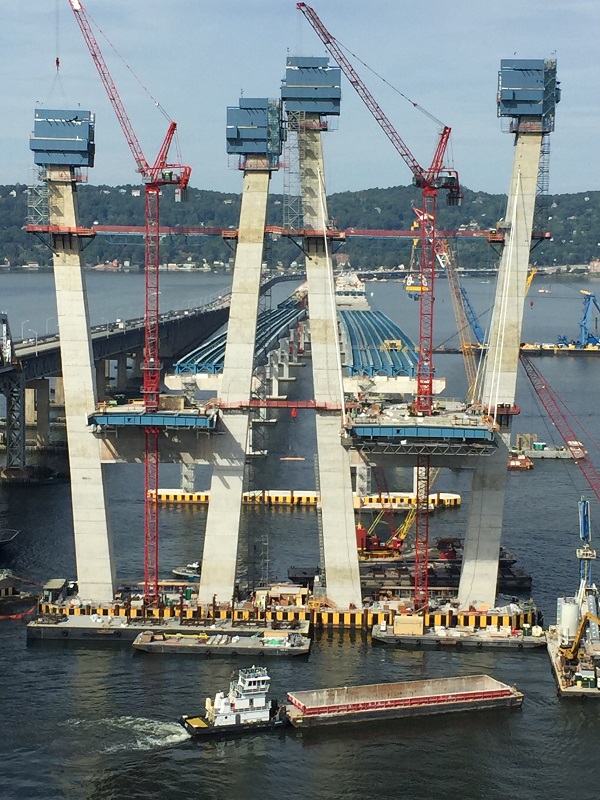
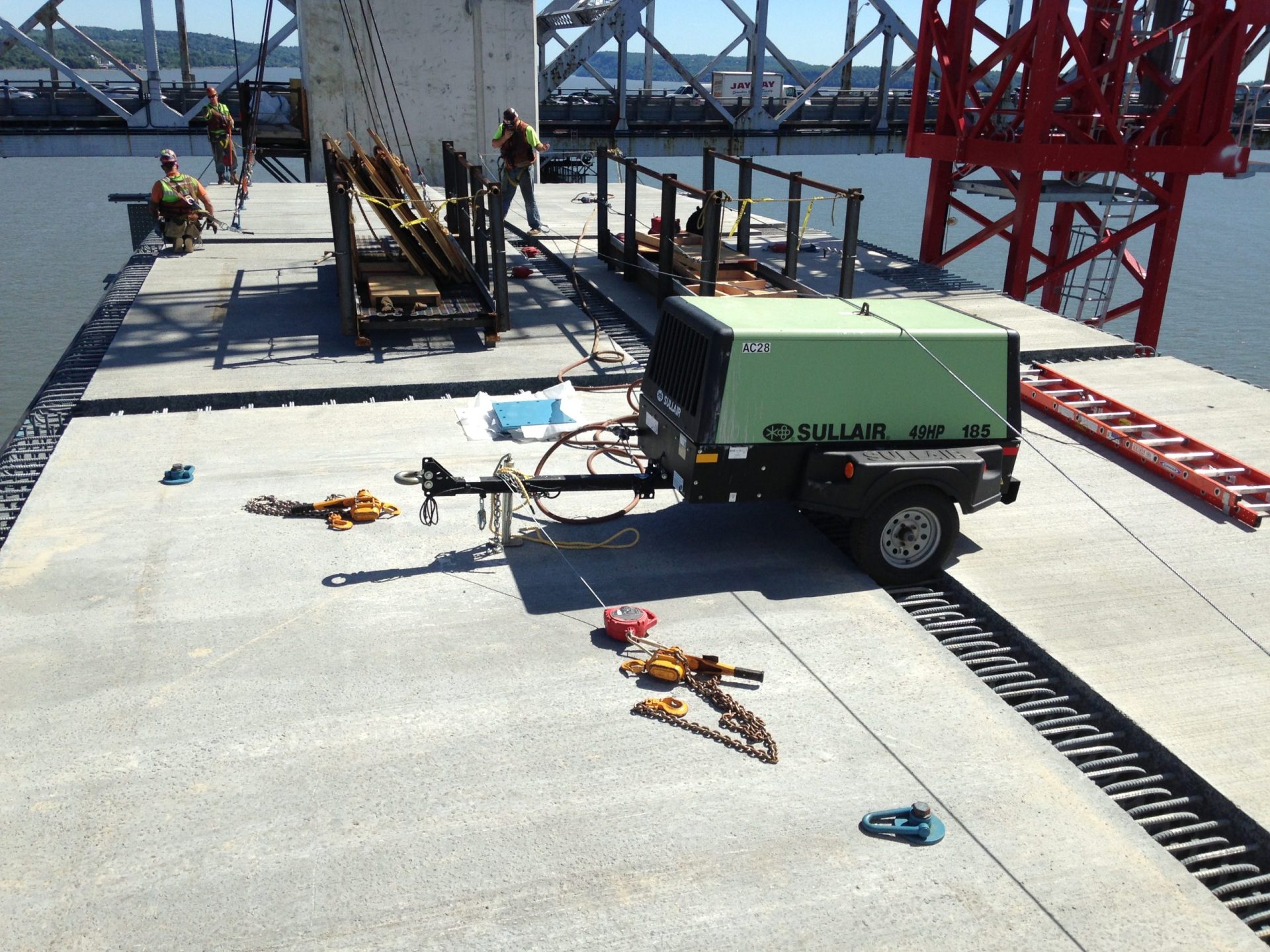
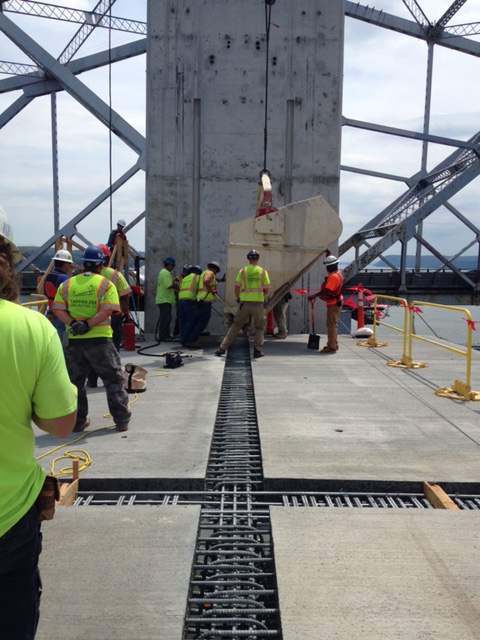
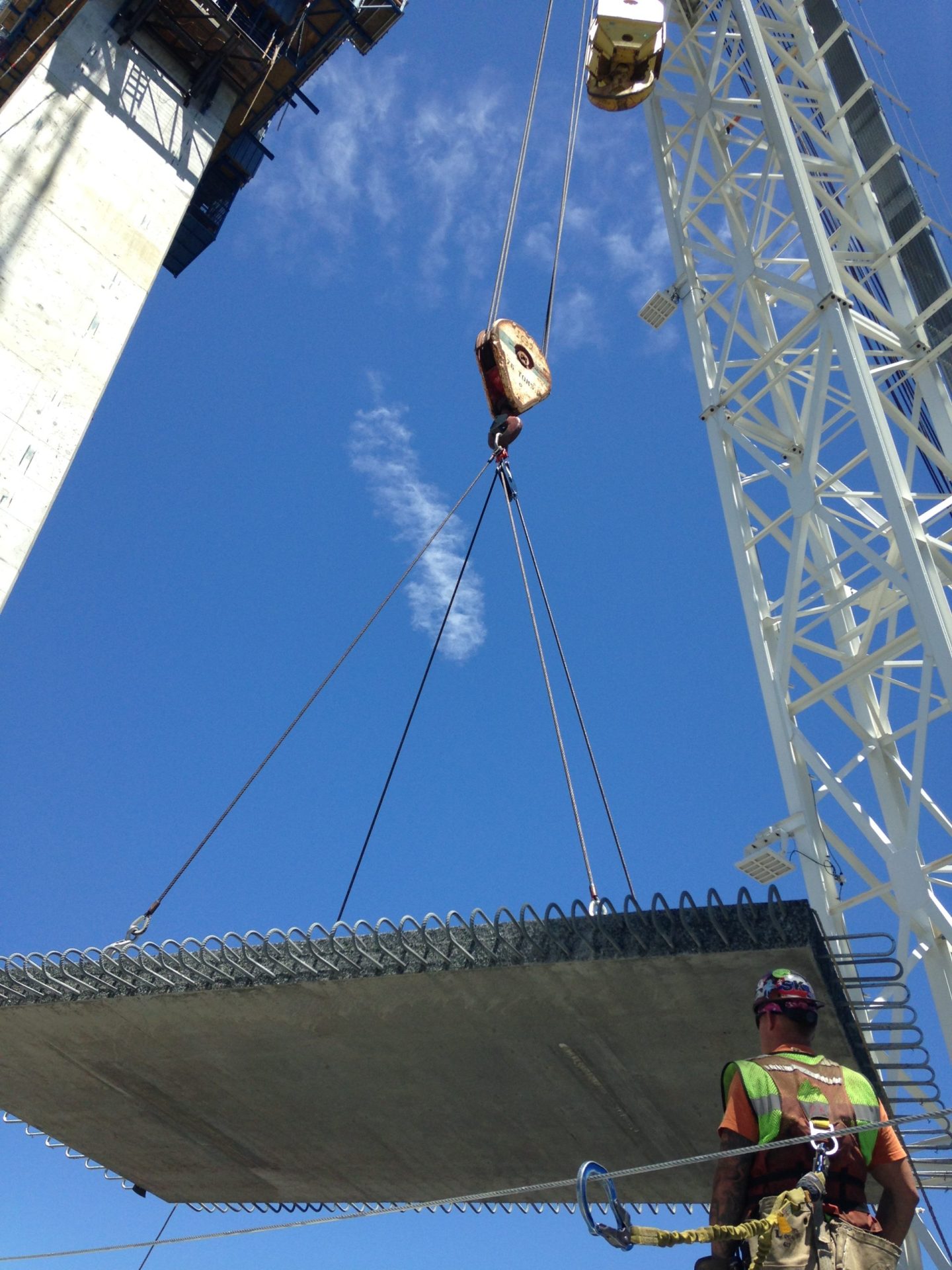
Fort Miller supplied 975 high-performance precast bridge deck panels and modular components for the Governor Mario M. Cuomo Bridge, built for a 100-year life.
Tappan Zee Bridge
Tarrytown, NY
Project Details
- Owner: New York State Thruway Authority
- Contractor: Tappan Zee Constructors, LLC
- Completion Date:
- 2013: Construction of the new bridge begins
- August 2017: The first span opens to traffic, completing the twin-span bridge
- 2018: The second span opens to traffic, completing the twin-span bridge
- 2020: A shared-use path for pedestrians and cyclists opens
- 2023: A multimillion-dollar project begins to enhance the bridge and surrounding areas, including improvements to Route 9 and the addition of a pedestrian bridge between Tarrytown and Irvington
- Scope: 975 Deck Panels, High-Strength Concrete, Highway Barrier, Lagging Wall Panels, Super-Slab®, T-WALL®, Noise Walls, 3-sided Bridge, Anchor Blocks
Project Overview
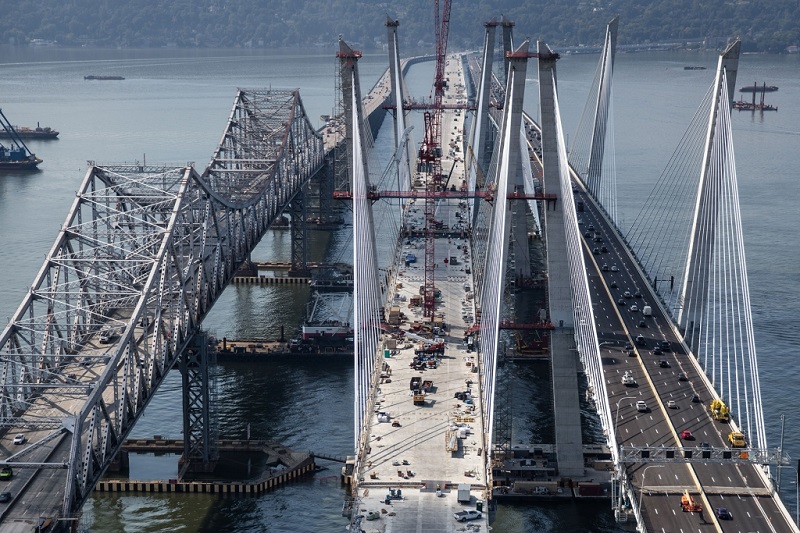
Spanning 3.1 miles across the Hudson River, the Governor Mario M. Cuomo Bridge anchors the Hudson Valley and the New York City region, carrying roughly 140,000 vehicles every day as the highway concurrency of Interstate 87 and Interstate 287.
Importantly, the construction of the new bridge addressed critical structural and safety issues of the aging 1955-era Tappan Zee, ensuring long-term safety for the public.
Completed in 2019, it was one of the largest design-build infrastructure projects in U.S. history and the largest bridge project ever undertaken in New York State.
Fort Miller Precast was selected to deliver the project’s high-performance precast bridge deck panels: 975 panels using a >10,000 psi mix engineered for 100-year service life. Beyond the main spans, Fort Miller supplied a suite of modular bridge components, helping the design-build team maintain speed, safety, and consistency on one of the nation’s most visible bridge programs.
Scope and Details
Replacing the aging Tappan Zee with a modern, multi-modal crossing was as much about reliability and community benefit as it was about span length.
Fort Miller’s scope centered on precision manufacturing at scale. Each deck panel was produced under rigorous QC to hold geometry, finish, and cover across variable grades and superelevations typical of a long cable-stayed crossing. Using a specially engineered high-strength concrete mix (exceeding 10,000 psi) reduced permeability and boosted durability, supporting the bridge’s 100-year design horizon and lowering long-term maintenance exposure.
By precasting large sections off-site in a controlled environment, Fort Miller was able to achieve high quality and precision, while also reducing on-site labor and construction time. The use of modular, off-site fabricated components, from highway and asymmetrical barriers to Super-Slab® pavement, T-WALL® retaining wall units, noise walls, a three-sided underpass, and temporary anchor blocks supporting cable erection, enabled faster and safer assembly of the bridge.
By fabricating so much of the bridge off-site, the project team significantly compressed the construction schedule and mitigated risks. Critical tasks that would have been extremely difficult over water (such as casting huge pier caps or tying rebar at height) were completed in controlled precast yards, yielding “huge benefit in terms of schedule, reduced in-situ concrete volume, enhanced worker safety, and lower environmental risk.”
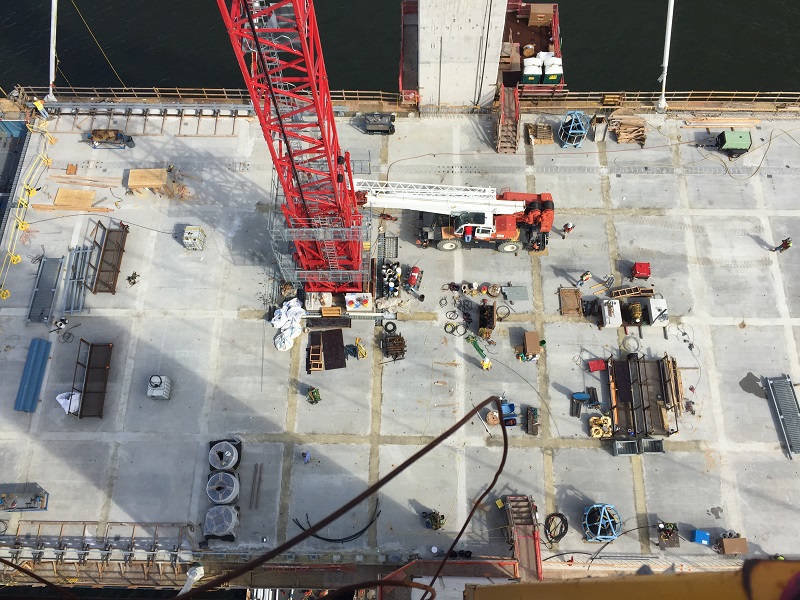
The precast deck system also allowed crews to install road panels rapidly, which was essential for the phased opening of the new spans while the old bridge was still in service.
The bridge greatly expanded capacity and improved safety, featuring eight general traffic lanes, dedicated bus lanes, full shoulders for emergencies, and cashless tolling to smooth traffic flow. It also includes a 12-foot-wide shared-use pedestrian/bicycle path with six scenic overlooks, making it a destination for cyclists and walkers.
Impact and Innovation
Fort Miller’s contributions exemplify innovation in precast technology, from the proprietary Super-Slab® system to the custom precast barriers and walls that fit the project’s needs. The company’s ability to deliver such a broad scope of precast products for a mega-project underscores its versatility and commitment to quality.
For the traveling public, the result is a safer, more resilient corridor: full shoulders, streamlined traffic flow, and a shared-use path that invites people onto the river. For the industry, the project proves that modular bridge components at a mega-project scale can raise the bar on quality, schedule certainty, and lifecycle performance.
Beyond its local benefits, the Governor Mario M. Cuomo Bridge has made waves in the engineering and construction industry, showcasing innovative approaches to building large-scale infrastructure. It has not only improved the daily lives of travelers and communities in New York but also pushed the boundaries of bridge engineering.
The bridge has received dozens of honors from professional organizations, including multiple ASCE Metropolitan Section awards, international engineering awards, and sustainability commendations. Of note is the 2019 PCI Design Award for “Best Special Solution” awarded by the Precast/Prestressed Concrete Institute.
Fort Miller Precast is proud to have been a substantial part of this accomplishment, from its high-strength concrete deck panels to its myriad precast components, helping to ensure that this iconic structure will safely carry people and commerce across the Hudson for the next century.

Resources & Downloads
Access our product resources and downloads for comprehensive information on our offerings.
Featured Bridge Projects
We have participated in some of the most celebrated bridge projects in recent memory, including the Alexander Hamilton Bridge/Highbridge Interchange, the Kosciuszko Bridge over Newtown Creek in Brooklyn-Queens, New York City, and the replacement of the Tappan Zee Bridge over the lower Hudson River.