


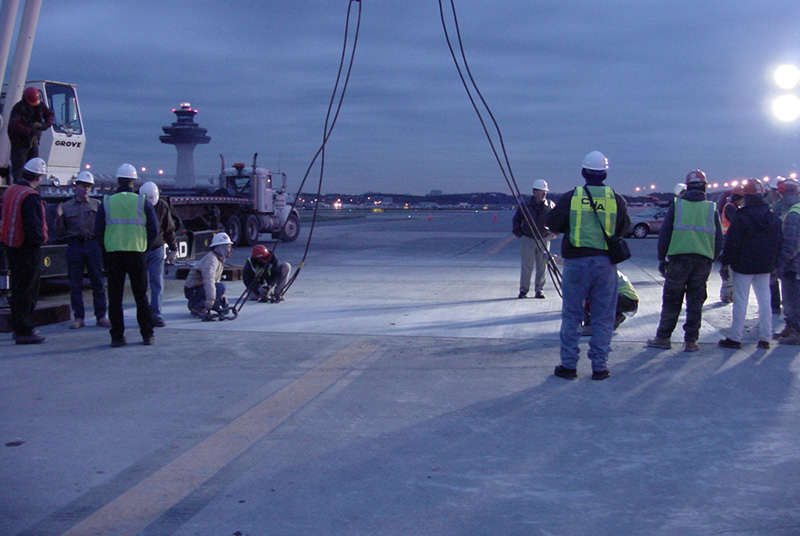
Washington Dulles International Airport
Washington, DC
Project Details
- Owner: Metropolitan Washington Airport Authority
- Contractor: The Lane Construction Corp.
- Designer: Clough, Harbour & Associates, LLP
- Completion Date: 2003
- Scope: (8) 25′ x 12.5′ Super-Slab® sections (4) 20′ x 12.5′ Super-Slab Sections
Project Overview
The Dulles taxiway rehabilitation project stands as a powerful case study in accelerated airfield pavement repair. Faced with the challenge of replacing full-depth concrete pavement at a major international airport, project stakeholders opted for a groundbreaking solution: Fort Miller’s Super-Slab® precast concrete system.
Unlike traditional cast-in-place repairs, which require hours or days to cure, Super-Slab® installations are ready for aircraft loads the same night. Compared to temporary asphalt patches, which degrade quickly under jet traffic, this system delivers a jet fuel-resistant, long-lasting surface designed to withstand the demands of modern aviation.
This innovative approach set a new standard for airport pavement replacement, proving that large-scale upgrades can be completed in tight timeframes without compromising quality or safety.
Scope and Details
Historically, replacing runway or taxiway concrete meant closures lasting days or weeks, or relying on fast-curing concrete over multiple short night shifts. This made planning and execution complex and increased the risk of delays. Fort Miller’s Super-Slab® precast solution was engineered to address a fundamental aviation challenge: how to complete critical airfield upgrades without halting operations.
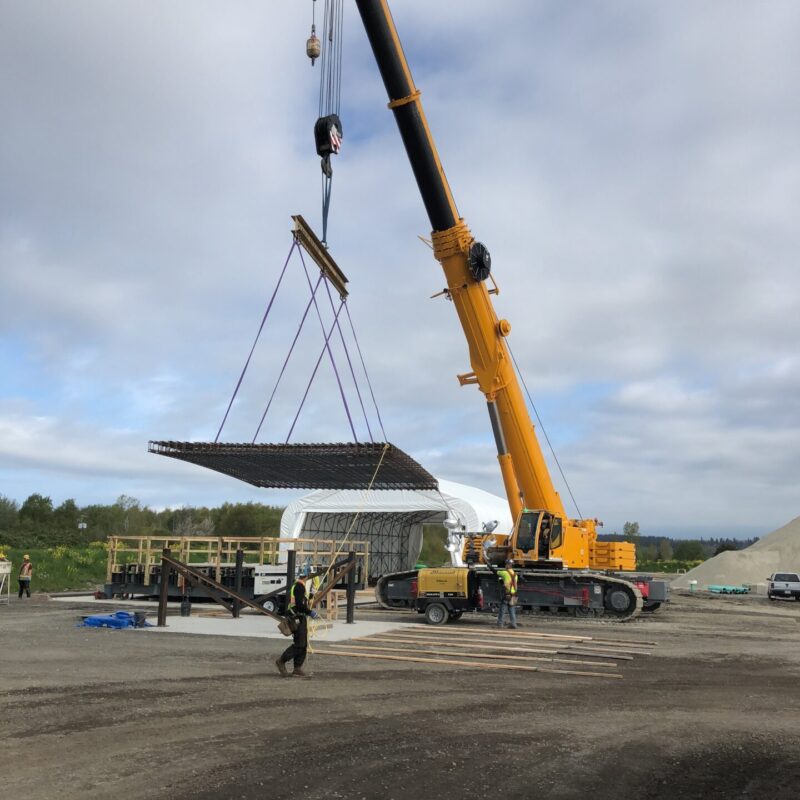
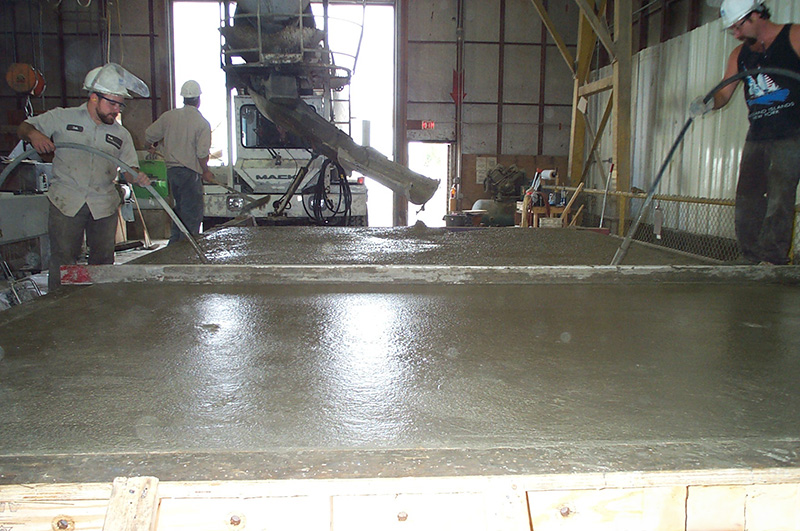
Super-Slab® panels are manufactured in a controlled plant environment, delivering consistent quality and high strength. Each slab is custom-cast to match the project’s specific geometry, ensuring a precise fit with the existing pavement.
At Dulles, the precast slabs were intentionally warped during casting to match the taxiway’s superelevated cross-slope and adjoining slab elevations. This ensured a seamless tie-in with adjacent pavement, maintaining ride smoothness and avoiding bumps or differential settlement.
The panels were heavily reinforced with steel to achieve the required strength with a thinner section. This high-strength-to-thickness design meant the existing base layers did not need removal or reconstruction. Despite heavier aircraft loads, the precast panels could carry the load on the original base, saving considerable excavation and work time.
This approach contrasts with traditional cast-in-place construction, which would require setting forms, pouring concrete, finishing, and then waiting hours (or days) for the slab to gain strength before it could bear aircraft loads.
Even using fast-setting concrete mixtures (an FAA-approved rapid construction method), a cast-in-place repair typically demands a minimum 4-6 hour cure and careful timing to achieve the required strength.
At Dulles, a 50×50 ft section of Taxiway Bravo was replaced over just two nights. A separate 25×40 ft section of Taxiway Yankee was fully reconstructed in a single 8.5-hour overnight closure. In both cases, the pavement reopened the following morning with zero lost operating hours, preventing flight delays and maintaining operational continuity.
By eliminating lengthy curing periods and reducing construction staging, this project showcased a model for maintaining operations during infrastructure upgrades. The FAA and industry observers have cited this success as a leading example of accelerated airfield pavement repair in high-traffic environments.
Impact and Innovation
Projects like the Dulles taxiway overhaul highlight the core benefits of accelerated airfield pavement repair using precast concrete technology: overnight installation speed, seamless integration with existing runways/taxiways, excellent long-term performance under jet loads, and a more favorable life-cycle cost when operational impacts are considered.
The Super-Slab® precast pavement system has proven to dramatically improve construction speed, reliability, and longevity for critical airport pavements. The immediate benefit is in installation speed: precast panel replacements can be executed in short overnight windows, restoring full service by morning.
Beyond speed, precast concrete panels offer the durability of high-quality factory-produced concrete, often outperforming typical field-placed concrete or temporary asphalt patches over the pavement’s life.
The Dulles project showcases how rapid reconstruction methods like Fort Miller’s Super-Slab® precast pavement system can modernize aging infrastructure with minimal impact on operations.
Airport authorities are increasingly adopting this system for its ability to balance speed, safety, and sustainability. The success at Dulles has influenced the FAA’s evolving guidance on “fast-track” pavement options, and the technology has now been deployed across 100+ projects nationwide.
Resources & Downloads
Access our product resources and downloads for comprehensive information on our offerings.
Featured Airport Projects
Operations in and around airports can significantly disrupt passengers, airport functions, and airline services. Fort Miller Precast specializes in manufacturing a diverse range of products tailored for airports, including precast bridge units, pedestrian walkways, overnight taxiway repairs, and beyond. Our expertise lies in minimizing disruptions for all stakeholders involved, ensuring seamless operations and passenger experiences.