
When infrastructure meets history, solutions must be precise, adaptable, and respectful of the past. That’s exactly what happened in Colesville, New York, where a new precast concrete box culvert system was installed beneath a stone arch bridge on NYS Route 7. Designed to accommodate a tributary of Osborne Creek, this unique project balanced 21st-century engineering needs with historic preservation.
Built in 1889, this historic arch is an active train bridge to this day, a testament to its 19th-century engineering. However, modern needs arose beneath this arch. By the 2010s, it became necessary to install a new culvert under NYS Route 7 to handle the Osborne Creek tributary’s flow and prevent roadway flooding.
The challenge was clear: how to upgrade the waterway and road infrastructure to current standards without disturbing the beloved 136-year-old stone arch above.
New York State Department of Transportation (NYSDOT) officials and engineers turned to Fort Miller, a leading precast concrete manufacturer, to ensure the project achieved its technical goals while protecting an important piece of Broome County’s infrastructure heritage.
The Challenge: Stream Diversion Without Structural Disruption

At the heart of this project was a complex goal: install a culvert that would divert stream water under NYS Route 7, without disturbing the historic stone arch bridge above it.
Engineers opted for a creative solution: thread the new culvert through the site in a way that left the stone arch untouched. This meant designing the culvert with a serpentine alignment to navigate around the arch’s foundations and other obstructions. Any new structure had to fit within the limited space and odd angles dictated by the historic bridge, a task far beyond a standard on-site concrete pour. It was evident that a precast concrete approach, with precisely engineered segments, would be the optimal choice to meet these constraints.
New York State DOT Region 9 and contractor Gorick Construction turned to Fort Miller Precast for a custom-engineered culvert solution.
Fort Miller’s Precast Concrete Box Culverts: Custom Fit, High Performance
To meet these complex site demands, Fort Miller produced a total of 41 precast concrete box culvert segments, each 10 feet wide and 4 feet high, forming two side-by-side channels for the stream flow.
Twin “V” bottom profiles for optimal hydraulic performance, concentrating low flows toward the middle to keep sediment from building up and reducing maintenance needs.
Six of these segments were specially cast in a “pie” shape to allow the culvert to bend along the stream’s centerline, snaking through the available space without gaps. This level of customization is a hallmark of Fort Miller’s precast approach: each project’s pieces are tailored to fit site-specific requirements, whether it’s unusual skews, bends, or gradient changes.
Fort Miller’s precision-molded segments, produced under controlled conditions, ensured a perfect fit upon delivery.
Key Benefits of Fort Miller’s Precast Concrete Solution:
- Custom alignment: Curved installation using pie-shaped units
- Hydraulic efficiency: V-bottom channel improves flow and reduces sedimentation
- Speed and precision: Fabricated in a controlled precast concrete plant to minimize on-site delays
- Historic preservation: No disturbance to the 1889 stone arch
- Emergency readiness: Outlet pool for firefighting in rural area
Threading the Culvert Under the Arch: Efficient Installation Under Complex Conditions

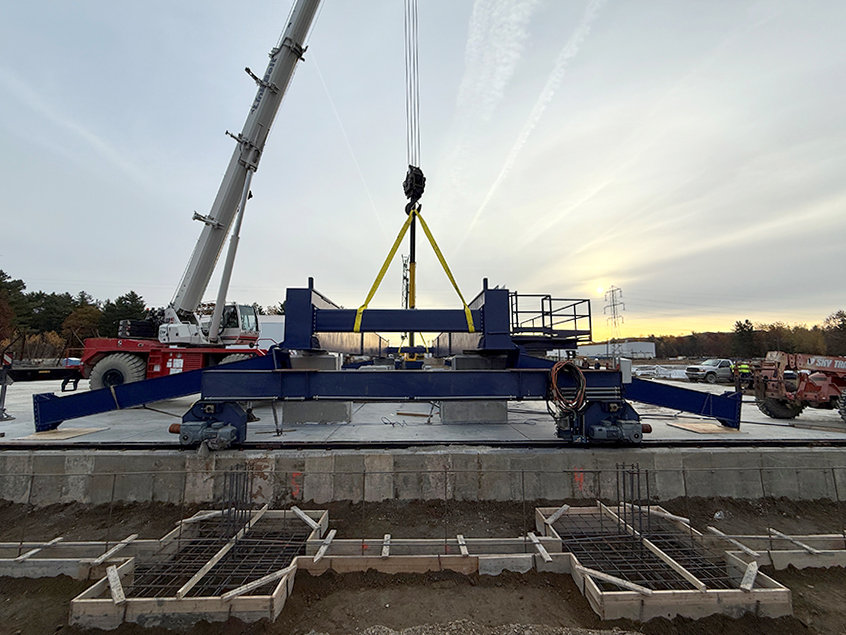
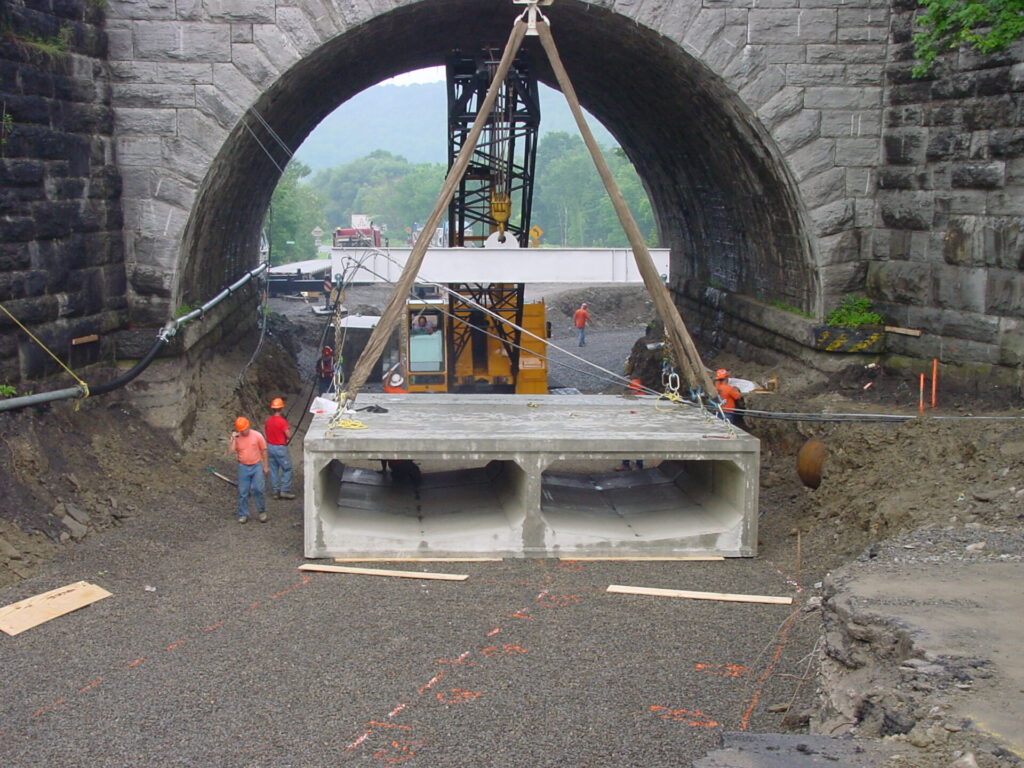
Actual construction required as much finesse as the design. Each precast section had to be placed precisely along the curved path beneath the stone arch. The contractor, Gorick Construction, utilized a short-boomed crawler crane to lift and maneuver the culvert units into position in the tight space under the bridge. The reduced boom length gave the operator better control and clearance under the low arch, preventing any accidental contact with the historic masonry.
Working in a confined corridor like this also meant managing the creek flow carefully. To enable dry installation conditions, stream water was temporarily diverted through a pipe, protecting both the workers and the integrity of the structure.
Fort Miller’s segments fit together seamlessly. Thanks to the detailed engineering up front, the tongue-and-groove joints of the precast boxes ensured a snug connection, forming a continuous twin-cell tunnel for the water.
As the culvert sections were set, crews also constructed any needed headwalls or wingwalls at the inlet and outlet. Once complete, the stream was redirected through the culvert. The result was a seamless new underground waterway running directly below the old stone arch, with zero impact on the arch’s structure or alignment. ride for aircraft. By the end of the third night, all twelve precast panels were grouted in place, and the rehabilitated taxiway slab section was ready for use.
Preserving a Landmark, Delivering Modern Infrastructure
The successful completion of the County Route 7 culvert project in Colesville brilliantly demonstrates how precast concrete components can marry modern engineering needs with historic preservation.
In addition to meeting hydraulic and structural needs, the use of precast concrete box culverts allowed the project team to complete the work efficiently, safely, and without extended road closures or disruption to the surrounding area.
In this case, accelerated installation minimized the time excavations were open under the arch and reduced the period of environmental disturbance to the stream. The partnership between Fort Miller, NYSDOT Region 9, and the contractor exemplified how collaboration and the right choice of technology can solve complex problems.
Trust Fort Miller for Your Next Precast Concrete Bridge or Box Culvert Project
In narrative terms, the Osborne Creek culvert project reads almost like threading a needle: weaving a modern concrete structure through the eye of a historic arch.
For engineers, architects, and DOT officials, this project is a compelling case study in how precast concrete can provide cutting-edge solutions that respect and preserve historical structures.
Whether you’re navigating tight right-of-ways, historic preservation requirements, or custom geometries, Fort Miller delivers engineered solutions that get the job done—safely, efficiently, and with lasting quality. As a trusted precast concrete supplier, we provide precast concrete structures that combine strength, durability, and flexibility for transportation and utility infrastructure projects across the Northeast and beyond.
Looking for a partner for your next complex culvert or bridge replacement? Contact Fort Miller today to learn more about our full line of precast concrete box culverts and custom precast concrete structures.